
Fridge Repair Cost: Complete Breakdown of Prices, Labour & When to Replace
If your fridge stops cooling, leaks water, makes unusual noises, or runs constantly, the first question you’ll ask is: how much does fridge repair cost? In most cases, fridge repair costs range between $180 and $450+, depending on the fault, the appliance type, and whether replacement parts are required. Minor repairs that don’t require new components are typically more affordable, while compressor or sealed system failures sit at the higher end of the range. Understanding how repair pricing works helps you decide whether fixing or replacing the unit makes financial sense.
Call-out fees are usually the first cost you’ll encounter. Most Auckland appliance technicians charge a set fee to visit your home and diagnose the fridge. This fee often ranges from about $100 to $150 in the Auckland area , and sometimes it includes a small amount of labor time (e.g. the first 10–15 minutes of diagnosis). After that, technicians charge for additional labor, typically around $120 per hour (billed in 15-minute increments) . So even for a very quick fix, you’re likely to pay at least the call-out charge (~$100+). If parts are needed, their cost is added on top.
Typical Fridge Repair Cost Breakdown (NZD)
To give you a clearer picture, here’s an approximate breakdown of fridge repair costs by type of repair. Keep in mind these are general ranges for Auckland and actual prices can vary with brand and model:
| Type of Repair | Typical Cost Range | Notes |
|---|---|---|
| Thermostat Replacement | $250 – $450 | Includes new thermostat part and labor. A simple thermostat fix might be on the lower end; complex electronic controls could cost more. |
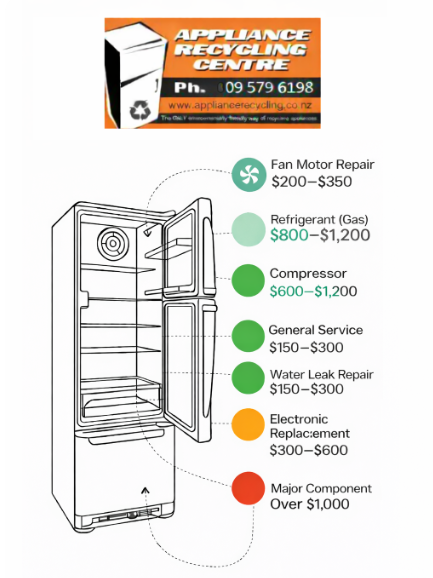
| Compressor Repair/Replacement | $800 – $1,200+ | Usually the most expensive repair. Compressors are costly and labor-intensive to replace. Often not economical if on the high end. |
| Refrigerant (Gas) Refill | $800 – $1200 | The refrigerant gas itself is very expensive , but so is locating and fixing the leak (if required) adds to cost. And it is illegal to simply “top up” the gas , leaks MUST be repaired |
| Door Seal Replacement | $150 – $300 | A new gasket/seal typically costs ~$80–$150 for common models and the rest is labor. Ensures the fridge closes airtight (important for efficiency) . DIY-minded owners sometimes do this cheaper by ordering a seal and fitting it. |
| Fan Motor Repair (evaporator or condenser fan) | $200 – $350 | Replacing a faulty fridge fan motor (part ~$80–$100 ) plus labor usually lands in this range. A bad fan can cause poor cooling or loud noises. |
| General Servicing (cleaning coils, minor tune-up) | $100 – $150 | Often just the call-out fee. Many Auckland technicians will clean condenser coils, check temperature and door seals as part of a service call. Regular servicing can prevent bigger issues. |
Why do costs vary so much? Small fixes (like replacing a thermostat sensor or sealing a coolant leak) involve less time and cheaper parts than something like swapping out a compressor or electronic control board. For instance, replacing a simple thermostat might be a quick job, whereas a compressor replacement is essentially like doing surgery on your fridge – it can cost over $1,000 in some cases and may require special refrigeration technicians. It’s not uncommon that if a compressor fails on an old fridge, technicians will advise considering a new fridge instead, given the high cost.
“Many fridge repairs could be avoided if people noticed the early signs. Things like strange noises, minor leaks, or doors not sealing properly—address these quickly, and you’ll usually save yourself hundreds down the line.”
– Tama Flynn, Founder of Ajax Appliance Repairs
How Much Does Fridge Repair Cost in Auckland?
Most fridge repairs fall into three practical cost categories depending on complexity and parts required.
Minor Repair (No Parts Required) — $180 to $220
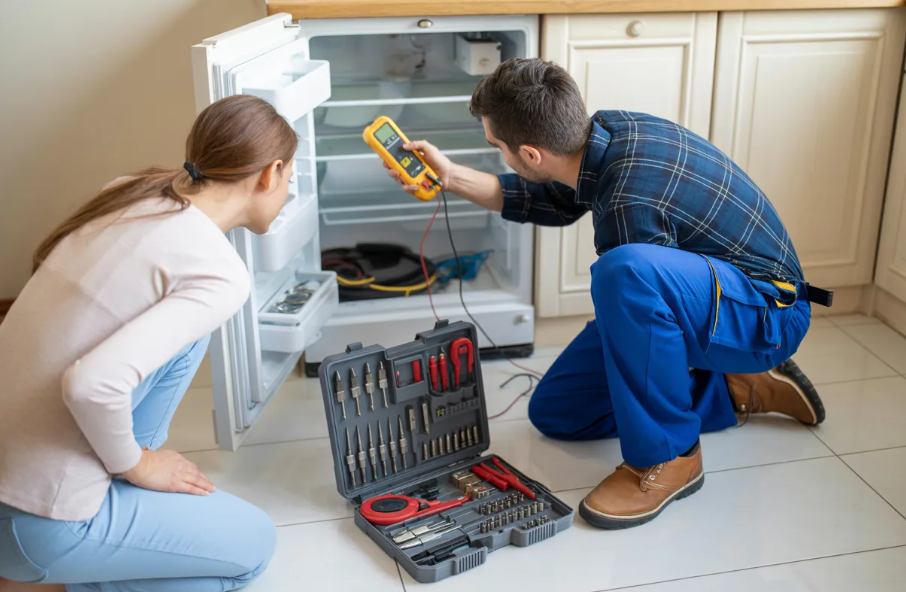
This pricing category applies when the fault can be diagnosed and corrected within the initial service visit without replacing any internal components. These are typically early-stage issues where the appliance itself is still mechanically sound but experiencing a minor blockage, calibration issue, or safety interruption.
-
Call-out and professional diagnosis includes technician travel to your property, a full electrical safety inspection, voltage testing, and systematic component checks to accurately isolate the underlying cause of the issue. Proper diagnosis prevents unnecessary part replacement and ensures the correct fault is identified before any repair work begins.
-
Minor adjustments or resets such as clearing a blocked defrost drain, removing debris from airflow channels, resetting thermal safety cut-outs, or recalibrating a thermostat can often restore normal cooling performance without installing new components. Many cooling issues stem from airflow restrictions or sensor misalignment rather than part failure, which is why early inspection is valuable.
-
Performance verification testing ensures the fridge compressor cycles correctly, internal fans operate smoothly, and temperature stabilises within safe food-storage ranges before the job is completed. The technician confirms that both the fridge and freezer compartments are cooling evenly and that the issue does not reoccur under load conditions.
Because no replacement parts are required and labour time is typically contained within the standard service window, these repairs remain at the lower end of overall fridge repair cost. Acting early when symptoms first appear significantly increases the likelihood that the repair stays within this minor category rather than escalating into a more expensive component failure.
Standard Repair (Parts Required) — $220 to $450+
This category covers component replacements required to restore proper cooling, airflow, and temperature control when a part has genuinely failed rather than simply needing adjustment. These repairs are common in fridges between 5–10 years old where mechanical wear or sensor drift begins to appear.
-
Thermostat or temperature sensor replacement corrects inaccurate internal temperature readings that cause food spoilage, freezing in the fresh food compartment, or inconsistent cooling cycles. When the sensor misreads cabinet temperature, the compressor either runs too frequently or not enough, increasing energy use and stressing other components over time.
-
Evaporator or condenser fan motor replacement restores correct airflow circulation throughout the cooling system, which is essential for even temperature distribution between compartments. A failing fan can lead to warm fridge sections, frost build-up, unusual noises, or longer compressor run times due to poor heat exchange efficiency.
-
Defrost system component replacement resolves excessive ice build-up caused by failed defrost heaters, timers, or thermistors that interrupt the automatic defrost cycle. When frost accumulates around the evaporator coil, airflow becomes restricted, cooling performance drops, and internal temperatures become unstable.
Final repair cost in this category depends primarily on the type of part required, brand-specific component pricing, and the labour time needed to access internal panels safely. Fridges with tighter internal layouts or built-in designs may increase labour time slightly due to disassembly requirements.
 Major Repair (Compressor or Sealed System) — $600 to $1,200+
Major refrigeration faults involve the sealed cooling circuit — the core system responsible for heat exchange and temperature regulation. These repairs require specialist refrigeration tools, certified gas handling qualifications, and strict compliance with environmental regulations. While less common than minor component failures, they are significantly more complex and therefore sit at the higher end of fridge repair cost.
-
Compressor replacement requires disconnecting the sealed compressor unit, carefully cutting and re-brazing copper refrigerant lines, installing the new compressor, evacuating the system to remove air and moisture, and accurately recharging refrigerant to manufacturer specifications. The compressor is the mechanical heart of the refrigeration cycle, and precision during installation is critical to ensure correct pressure balance, energy efficiency, and long-term reliability.
-
Refrigerant leak detection and recharge involves pressure testing the cooling system to locate the leak source, repairing the affected section (often via brazing or component replacement), performing a deep vacuum to remove contaminants, and refilling the system with the correct refrigerant type and charge weight. Even small leaks can reduce cooling performance significantly, and improper charging can cause overheating or premature compressor failure.
-
Sealed system repair includes work on internal evaporator coils, capillary tubes, filter driers, and condenser lines that regulate refrigerant flow and heat transfer. These components are integral to maintaining stable internal temperatures, and repairs must be performed using specialised refrigeration gauges, vacuum pumps, and recovery units to ensure safety and compliance.
At this level of repair, the financial decision becomes more strategic rather than purely technical. If the fridge is over 10–12 years old, has declining energy efficiency, or shows signs of multiple component wear, investing $800–$1,200 into a sealed system repair may not deliver long-term value. In contrast, newer fridges with strong build quality and otherwise stable components can justify major repair investment. Careful assessment of age, efficiency, and overall condition helps determine whether repair or replacement is the smarter option.
Fridge Repair Cost Breakdown: Parts vs Labour
Understanding invoice structure helps clarify total pricing.
Call-Out / Diagnostic Fee — $98 to $170
-
Covers technician travel and attendance, ensuring a professional inspection is completed before committing to repair.
-
Includes the first 15–30 minutes of labour, during which electrical systems and cooling components are tested.
-
Provides a clear quote before proceeding, allowing you to approve the repair confidently.
This ensures accurate fault identification before additional costs occur.
Labour Charges
-
Incremental billing models charge additional labour in time blocks when repairs exceed the diagnostic window, reflecting the actual time required.
-
Flat labour cap structures offer pricing certainty, especially for common repairs.
Built-in or tightly installed fridges may require additional labour due to restricted access.
Parts Pricing
-
Thermostats and sensors are moderately priced precision components that must be calibrated correctly for accurate temperature control.
-
Fan motors fall within mid-range pricing and require careful panel removal for safe installation.
-
Control boards (PCBs) increase cost significantly due to digital complexity and integration with cooling systems.
-
Compressors are the highest-value component and significantly influence total repair pricing.
The failed component typically determines where your fridge repair cost falls within the range.
Fridge Repair Cost by Fridge Type
Fridge repair cost is not determined by the fault alone — appliance design plays a significant role in labour time, parts pricing, and overall diagnostic complexity. Internal layout, cooling configuration, and installation method directly influence how long a technician needs to access and repair components.
Single-Door Fridges
Single-door fridges have simpler internal layouts with one cooling circuit and fewer electronic components, which generally makes them quicker and more straightforward to diagnose and repair. Because there is only one temperature control zone and limited airflow routing, accessing parts such as thermostats, fans, or defrost heaters typically requires less disassembly. This reduced complexity often keeps labour time lower and makes these units more affordable to service compared to multi-compartment designs.
Fridge-Freezer Combinations
Fridge-freezer combination units contain separate fresh food and freezer compartments, each relying on controlled airflow and defrost systems to maintain stable temperatures. These models often include additional fan motors, dampers, and sensors to balance cooling between zones. When faults occur, technicians must test multiple components to isolate the issue, and accessing internal parts may require removal of freezer panels and shelving. The added components and layered airflow systems typically increase both labour time and potential parts pricing.
French Door Refrigerators
French door refrigerators are more advanced appliances that often feature dual evaporators, digital control boards, multi-sensor temperature monitoring, and complex airflow distribution systems. These features improve performance and energy efficiency but significantly increase diagnostic complexity when faults develop. Electronic control boards and proprietary components in these models are typically more expensive to replace, and labour time increases due to additional panels and compartment separation. As a result, French door fridge repair cost generally sits above simpler single-door or basic combination models.
Built-In or Integrated Fridges
Built-in and integrated fridges are installed within cabinetry and often secured in place to align seamlessly with kitchen design. While this provides aesthetic benefits, it increases labour time during repair because the unit must often be partially or fully removed before internal components can be accessed. Restricted access can extend service time, and reinstallation requires careful positioning to maintain ventilation clearances. These factors commonly push overall repair pricing higher compared to freestanding models.
What Other Factors Influence Fridge Repair Cost?
While the type of fault is the primary driver of fridge repair cost, several additional variables can significantly affect your final invoice. Two appliances with similar symptoms may still differ in pricing depending on age, brand complexity, and service conditions.
-
Age of the appliance affects repair practicality because fridges over 10–12 years old often experience multiple component wear at the same time. Older units may have weakened compressors, aging seals, declining insulation performance, and outdated control systems, which increases the risk of secondary failures shortly after repair. As appliances age, parts may also become discontinued or harder to source, adding to overall repair cost and downtime.
-
Brand and model design directly influence part pricing and diagnostic complexity, as premium or imported brands often use proprietary components and integrated electronic systems. European or high-end models typically contain advanced digital boards, dual cooling circuits, or specialised refrigerants that increase both component cost and labour time. Servicing these models may also require brand-specific parts that carry higher replacement pricing.
-
Parts availability can impact total cost if components must be ordered from overseas suppliers or are temporarily out of stock. Extended wait times may require additional labour visits for installation once parts arrive, and freight costs can increase pricing depending on sourcing location. Common domestic models usually have faster, more affordable part access compared to niche or discontinued units.
-
Urgency of service may increase pricing when after-hours, weekend, or priority attendance is required. Emergency service requests often involve adjusted labour rates due to scheduling changes and immediate technician allocation. Planned service during standard hours typically reduces overall cost compared to urgent or same-day call-outs.
-
Overall appliance condition influences whether additional components are likely to fail soon after the initial repair. For example, if a fan motor fails in an older fridge with a weakening compressor, replacing one component may not fully restore long-term reliability. Technicians often assess surrounding parts to determine whether the repair will deliver sustainable performance or whether replacement is a more cost-effective option.
Together, these variables explain why fridge repair pricing can differ between seemingly similar appliances. A professional assessment considers not only the immediate fault but also the broader mechanical and economic context of the unit.
 How Long Do Fridges Last?
Most modern refrigerators have an average lifespan of 10 to 15 years, depending on build quality, maintenance habits, usage frequency, and environmental conditions such as ventilation and ambient temperature. Higher-end models with proper maintenance can sometimes exceed this range, while heavily used or poorly ventilated units may experience accelerated wear.
-
Under 5 years old, repairs are usually financially worthwhile because key components such as the compressor, evaporator system, and control board typically retain significant service life. At this stage, faults are often isolated incidents rather than signs of widespread mechanical decline, making repair a cost-effective solution compared to replacement.
-
Between 5 and 10 years old, repair decisions require closer evaluation of both fault severity and total repair cost relative to the appliance’s remaining lifespan. Many fridges in this range may experience fan motor, thermostat, or defrost system failures, which are generally manageable repairs. However, repeated electronic or sealed system faults may signal emerging reliability issues.
-
Over 10–12 years old, replacement may become more economical because energy efficiency typically declines and multiple components begin to wear simultaneously. Older insulation, aging compressors, weakened door seals, and outdated refrigerant systems can reduce cooling efficiency and increase electricity consumption, which adds long-term operating cost beyond the repair expense itself.
Understanding appliance lifespan helps determine overall repair value. A professional assessment considers not only whether the current fault can be fixed, but whether the repair meaningfully extends reliable service life or simply delays an inevitable replacement.
Is It Worth Repairing a Fridge?
A practical guideline often used in the industry is the 50% rule: if repair costs exceed 50% of the price of a new fridge, replacement may be the smarter investment. For example, a $900 compressor repair on an older unit may not justify the expense if a new fridge costs $1,800. However, a $280 thermostat replacement on a 6-year-old appliance is typically worthwhile. Appliance age, efficiency, and condition should guide your final decision.
NZ Consumer Guarantees & Warranty Considerations
New Zealand consumers benefit from protections under the Consumer Guarantees Act (CGA).
-
Manufacturer warranties may cover component failures within the stated period, reducing repair expense.
-
CGA provisions require appliances to last a reasonable time relative to cost and intended use, even beyond express warranty.
-
Proof of purchase strengthens claims and helps confirm eligibility for repair coverage.
Understanding your rights may reduce out-of-pocket repair costs.
 Signs Your Fridge Needs Repair
Recognising early warning signs can prevent minor faults from escalating into major refrigeration failures. Many expensive compressor and sealed system issues begin as small airflow or temperature regulation problems that go unnoticed.
-
Fridge not cooling properly may indicate thermostat malfunction, sensor failure, restricted airflow, compressor inefficiency, or low refrigerant levels requiring professional testing. If internal temperatures rise above safe food-storage levels, bacterial growth risk increases and the compressor may run excessively to compensate.
-
Water leaking from the base often points to a blocked defrost drain, cracked drain pan, or damaged door seals allowing warm air infiltration that produces condensation. Over time, persistent moisture can damage internal components and flooring if not resolved.
-
Unusual loud noises such as grinding, buzzing, or rattling may signal evaporator fan wear, condenser fan obstruction, or compressor strain. These noises typically indicate mechanical stress and, if ignored, can lead to premature motor or compressor failure.
-
Excessive frost build-up usually indicates defrost system malfunction involving heaters, timers, or thermistors that regulate automatic defrost cycles. Ice accumulation restricts airflow around evaporator coils, reducing cooling efficiency and increasing energy consumption.
-
Fridge running continuously suggests cooling inefficiency caused by faulty sensors, worn door seals, blocked condenser coils, or declining compressor performance. Continuous operation not only increases electricity use but also accelerates mechanical wear.
Addressing these symptoms early significantly reduces the likelihood of major component damage and helps contain overall fridge repair cost.
How to Reduce Future Fridge Repair Costs
Preventive maintenance plays a critical role in extending fridge lifespan and lowering long-term repair expenses. Small routine checks can reduce strain on key cooling components and prevent early system failure.
-
Clean condenser coils annually to prevent dust and debris accumulation that forces the compressor to work harder than necessary. Blocked coils reduce heat dissipation efficiency, increase power consumption, and accelerate compressor wear.
-
Inspect door seals regularly to ensure they remain flexible, airtight, and free from cracks. Worn seals allow warm air to enter the cabinet, causing longer cooling cycles and unnecessary compressor strain.
-
Avoid overloading internal shelves so airflow remains unrestricted throughout the fridge and freezer compartments. Proper air circulation ensures even temperature distribution and reduces compressor cycling frequency.
-
Monitor temperature fluctuations using internal thermometers to detect early irregular patterns. Sudden variations may indicate sensor drift or airflow blockage that can be corrected before larger failures occur.
Consistent preventive maintenance extends appliance lifespan, improves energy efficiency, and reduces the risk of unexpected high-cost repairs.
Final Thoughts on Fridge Repair Cost
Most fridge repair costs range between $180 and $450+, depending on fault type, labour requirements, and parts pricing. Minor repairs remain affordable, while compressor or sealed system work sits at the higher end. Before replacing your appliance, obtain a professional diagnosis. Many common faults are cost-effective to repair and significantly extend appliance life. If repair exceeds 50% of replacement value, especially on older units, upgrading may provide better long-term financial value.

- Oven Repair Cost (2026 Guide): Parts, Labour & Call-Out Fees Explained - February 23, 2026
- What Is the Average Dryer Repair Cost in 2026? - February 23, 2026
- How Much Does a Fridge Repair Typically Cost? - February 23, 2026